
For investors
Capital, ring-fenced and visible.
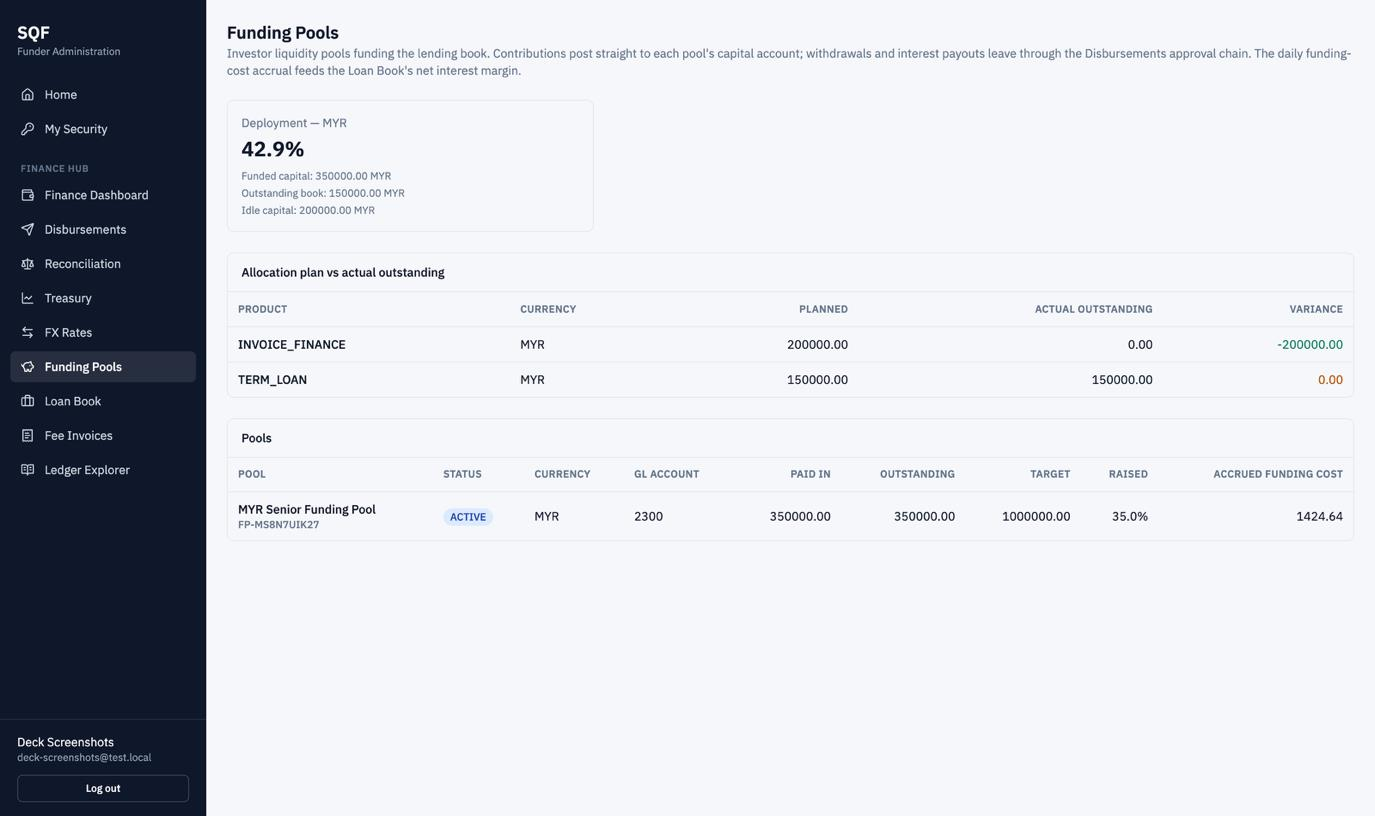
Funding pools put investor capital on a bank-grade ledger from the moment it arrives — deployed to an agreed plan, measured daily, and withdrawable only through the same approval chain as any other payment.
Mechanics
How a funding pool works
- Your own account on the books. Each pool gets a dedicated capital account on the double-entry ledger — investor money is visible on the books from the moment it arrives, not pooled into a blur.
- Every contribution on its own terms. Recorded at its agreed fixed rate, on its date. The daily cost of capital accrues automatically from day one.
- Deployed to plan. An allocation plan per lending product is compared against the actual outstanding book — deployment versus intention, on screen.
- No side doors. Withdrawals and interest payouts leave through the same four-eyes payment chain as any other money movement — prepared by one person, approved by another with a fresh authenticator code.
The honest number
Cost of capital, measured daily
RM 250,000 @ 6.5% p.a.
= RM 44.52 a day
Accrued daily and netted against lending yield — the funder’s true net interest margin, not a guess. Both sides of the margin are on the same ledger, provable at any moment.
Nothing edited, ever
Checked against real bank statements
The investor portal
Structured notes, subscribed and serviced online
A funder can now issue fixed-term notes against its book and take subscriptions through a portal of its own — onboarding, KYC, subscription, maturity and reporting in one place, on the same ledger as everything else.
01
Onboard once
02
Subscribe with a signature
03
Fund it your way
04
Choose what happens at maturity
The wallet is on the books, not beside them
The wording you sign is frozen with the issue
Transparency
See the network your capital funds
The knowledge graph shows the trade network behind the book — screened companies, real trading relationships, concentrations made visible. Capital deployed against something you can look at, not an abstract asset class.
Ask to see a pool's books.
The register, the accrual log and the trial balance — live, on demonstration data.